Accessibility · Mobile experience
Deaf Buddy
A learning companion for Teman Tuli. From research artefacts to a tested, inclusive mobile prototype.
- My role
- UI/UX Designer · Ideation, prototyping & usability testing
- Period
- 2024 — 2025
- Experience
- Mobile
A COLLABORATIVE THESIS PROJECT
Two theses. One design journey.
01 / FROM RESEARCH TO IDEATION
The artefacts came first.
Raka’s research → my analysis → design ideas.
02 / SHAPING THE IDEAS
From needs to ideas
From a user need to a design direction.
STEP 1 / 5
Requirements & ideas
I translated the research artefacts into nine requirements, then explored several possible solutions for each need.
Follow an offline lecture through real-time transcription.
- Live speech-to-text
- Larger, readable transcript text
- Automatically save the transcript
Ideas explored during ideation, before prioritisation and prototyping.
03 / THE PROTOTYPE DESIGN
Meet the main features.
Select a feature to see where it lives and how to use it.
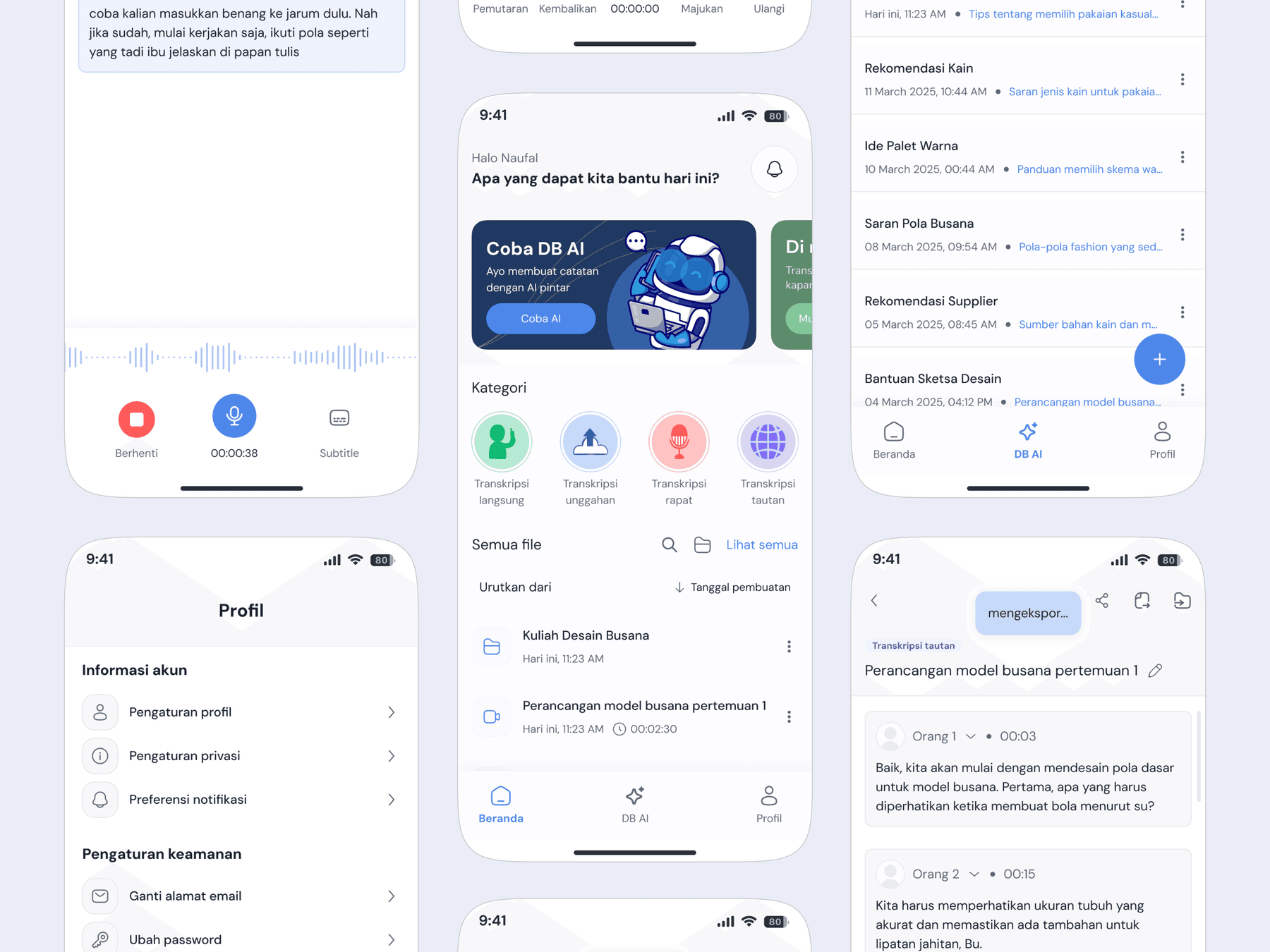
FEATURE 1 / 7
Live transcription
Follow an offline conversation as readable text.
How to use it
- Open Live transcribe from the home screen.
- Choose the language and microphone source.
- Start transcription, then pause or finish when needed.
04 / LIVE DEMO
Seven ways to learn.
Choose a journey, then try the buttons inside the prototype.
Live transcription
Follow a conversation through a live transcript.
Apa yang dapat kita bantu hari ini?
Kategori
4 fiturSemua file
Contoh transkripsi05 / LEARNING TOGETHER
Testing with Teman Tuli
Moderated usability testing using Maze and Short UEQ.
Active university students, supported by one sign-language interpreter (JBI).
15–17 March 2025 · one online session via Zoom; four in person at KFC Balai Pustaka.
Seven task scenarios, follow-up feedback, and an eight-item experience questionnaire.
How each task performed
Average Maze usability score: 57.43. Select a task to explore its result.
| Task | Direct success | Indirect success | Give-up | Misclicks | Avg. time | Score |
|---|---|---|---|---|---|---|
| 0% | 100% | 0% | 43.6% | 255.6s | 44 | |
| 0% | 100% | 0% | 39.5% | 38.3s | 41 | |
| 0% | 100% | 0% | 18.8% | 57s | 50 | |
| 0% | 100% | 0% | 3.1% | 16.3s | 50 | |
| 40% | 60% | 0% | 40.4% | 97.6s | 56 | |
| 100% | 0% | 0% | 36% | 29.1s | 89 | |
| 60% | 40% | 0% | 25.1% | 45.1s | 72 |
Live transcription
Everyone completed the task through an indirect path. Initial exploration contributed to the longest completion time; clearer first-use guidance became a priority.
Direct success follows the intended path; indirect success completes the task through another path. No participant gave up on any task. Maze scores combine several measures and are not completion percentages.
How the experience felt
Short UEQ · scale −3 to +3 · initial prototype
Perceived usefulness, ease, efficiency and clarity.
Perceived enjoyment, appeal and stimulation.
Positive reported experience alongside usability issues that still needed iteration.
From feedback to design decisions
Open a finding to see what changed.
Help me get startedParticipants 1, 2 and 3
What I heardFirst-time use needed a tutorial. Participant 3 also preferred visual instructions to long text.
Design responseIntroduce onboarding and visual coachmarks to explain the main actions.
Use familiar languageParticipants 3, 4 and 5
What I heardParticipants 3 and 4 requested Bahasa Indonesia; participant 5 preferred less formal language.
Design responseLocalise the interface and simplify the wording.
Make transcript details clearerParticipant 1
What I heardLanguage and source information were missing, filenames were inconsistent, and thin text was hard to read.
Design responseAdd source and language labels, standardise filenames, and improve text readability.
Show where editing happensParticipant 4
What I heardManual transcript editing was difficult to discover.
Design responseAdd an explicit manual-edit label instead of relying on an implicit interaction.
Source: thesis §4.3, Tables 6–8 and Figure 16. These results precede iteration; no post-iteration score is presented.
View the original Maze report
06 / FEEDBACK INTO DESIGN
Small changes. Clearer moments.
Drag the divider to compare.
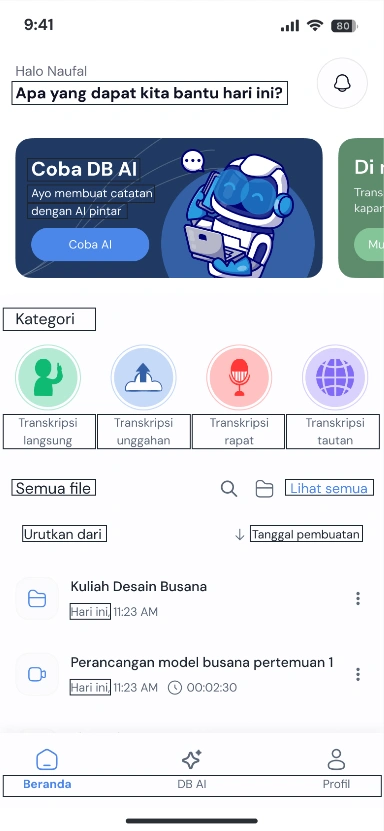
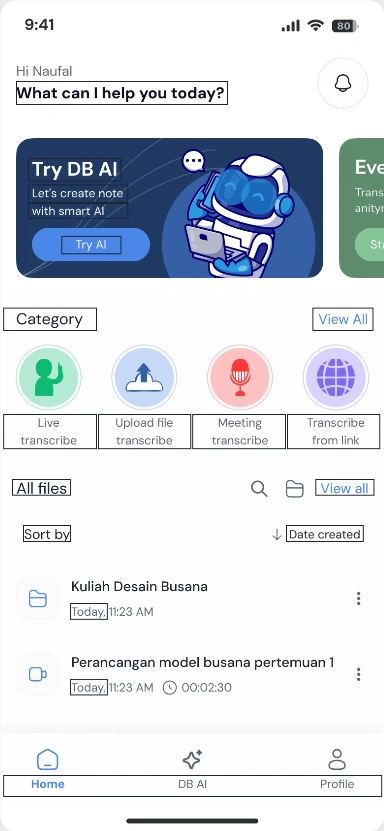 BeforeAfter
English → Bahasa Indonesia, following participant feedback.
Visuals from my 2025 IPB University thesis, “Pengembangan Prototipe Aplikasi Pembelajaran Inklusif untuk Teman Tuli dengan Design Thinking”. Scores are from initial testing, before iteration.
07 / CONCLUSION
Learning with Teman Tuli, designing for clarity.
Starting with Raka’s research artefacts, I translated user needs into ideas, an interactive prototype, and design iterations informed by five Teman Tuli. The result is a learning companion concept that brings transcription, editable notes, and AI-assisted explanations into one experience.
Useful features still need clear journeys.
Short UEQ recorded a positive overall experience of 1.825, while the initial Maze score of 57.43 exposed navigation and discoverability issues. Participants completed every task, but often took an indirect path.
Make the next action easier to understand.
Feedback guided visual coachmarks, more familiar Bahasa Indonesia, clearer transcript metadata, consistent filenames, and an explicit manual-edit label.
Clarity is part of accessibility.
Inclusive design needs understandable language, visible guidance, and input from the people using it. A next step would be to test the revised prototype again to measure whether these changes improve usability.
The reported scores describe the initial prototype. The revised design has no post-iteration testing score reported in this case study.
THANK YOU FOR READING